Showing posts with label gardening. Show all posts

Monday, June 23, 2014

Everett Street Garden

Four friends from high school asked me to build them a garden in their backyard.  Adjacent to a large cemetery, I quickly found that the condition of the soil was going to be very easy to work with. Additionally, the spot we chose for the garden get's a serious 9-10 hours of sunlight daily (which can be too much for some plants) but is certainly a good amount of sun for a new vegetable garden.

Here's what the area looked like as I started to get the ground prepared.


After taking off the layer of grass and moving that aside to continue growing on the lawn, I forked the entire area to get some air and light into the ground.  Although I planned to build a no dig garden, I did want the bottom of the garden to be as arid as possible.


Next, it was time to start building up.  First, a few layers of leaves and newspaper.


Here's what the area looked like after a few layers of all that organic matter.  The inks from the paper might not be the best for the garden, but the paper will break down naturally over time and help condition the soil by keeping in additional moisture.


Finally, I built up small areas of soil where I planted the initial bunch of veggies; I filled in the other areas with leaves, knowing that I would be adding more soil, compost, manure, etc. to the garden in due time.


This is still a work in progress, but here's what the garden looks like most recently; currently growing in the garden: tomatoes (three varieties), capsicums (three varieties), green beans, snap peas, eggplant, parsley, cucumber, zucchini, watermelon, radishes, lettuce, arugula...


Friday, June 20, 2014

Mullumbimby Community Garden Needs Your Help!

Mullumbimby Community Garden now has a crowdfunding campaign on Chuffed...Find out more HERE

DONATE HERE

Do you know what it feels like to lose an unsaved document on your computer?  Everything you've worked hard to complete; lost, in the blink of an eye.


Recently, some very dear friends of mine had those feelings amplified during the course of one night. The Mullumbimby Community Gardens, where I spent three months volunteering (February through May) lost all of their administrative belongings when fire wreaked havoc on their office.  Fire damage also affected other areas of the gardens including the Nursery, the Rotunda, and the Seed Savers Shed; all vital parts of this thriving organisation.  Eight years worth of records, files, photocopiers, and other electronic devices were destroyed.

Photo courtesy of Mullumbimby Community Gardens
All of this happened at a time when the team is preparing and ramping up for this year's Living Earth Festival.


Photo courtesy of Echo NETDAILY
Below are some images of the joy and wonder that the Mullumbimby Community Gardens offer; first, some images from the Living Earth Festival in 2013.

Photo courtesy of Mullumbimby Community Gardens

The nursery is a vital part of the MCG; seedlings are sprouted for use within the gardens and are also grown as a way to provide a small revenue stream for the gardens
The Food For All section is the most community oriented part of the gardens, where anyone from the community can come to harvest fruits and vegetables and make a donation according to what they feel the food is worth and what they can afford.


The Bunya Sustainability Fund has been an effective method of raising money for help around the gardens. Now, more than ever, the MCG needs your help.  Please make a tax deductible donation today and help the Mullumbimby Community Gardens pick up the pieces and continue preparing for this year's upcoming events.


Thursday, April 24, 2014

Radish and Pepper Overload

Capsicums grow really well in my garden.  I don't know if it's the climate here, or the soil composition (high nitrogen) in the raised beds; maybe it's a combination of both.  What it equals is constant sensory exploration (read: test how much spice the human body can tolerate!).  These habanero peppers turned into a few bottles of chili sauce...that recipe is still under construction.


Radishes and other varieties of capsicums (7 in total growing in the garden) also grow really well. When life gives you radishes and peppers, you make something with them...here's a recipe for Radish and Pepper Spread.


The green capsicums were all sliced and baked in the convection oven for roughly 30 minutes at 180C. I covered the lot of peppers in water and two tablespoons of sugar while they were baking.


After the peppers came out of the oven, one juiced lime, a tablespoon of olive oil, and a pinch of salt was stirred into the bowl.


Finally, add the diced radishes and red chilli peppers and you've got a delicious spread with a kick.


Try it on lentils...


...or on toast.


However you decide to spread your radishes and capsicums, enjoy!


Monday, December 23, 2013

Royal Veggies

The Royal Botanic Garden in Sydney has been collecting and studying plants since 1816.  Nearly two hundred years later, the gardens spread a massive 30 hectares south of the Sydney Harbour and house over 15 different feature gardens.  The first time I experienced the garden in 2012 I simply enjoyed a stroll around the park, as I made my way from The Rocks to Woolloomooloo.  Recently, as I showed my friend Carolyn the gardens for the first time, we stumbled upon the the vegetable gardening efforts currently going on in the park.


These raised beds are a great size and shape for easy maintenance.  Plants can be easily separated by size and variety.  I can't say I'm a huge fan of growing Papaya trees in raised beds, as I've gone through the process of removing them from my raised beds at home already.  However, there's plenty of room here and nearly a dozen raised beds so using one for some fruit trees works.


My favorite part of the garden, and what really caught my attention to document the project were these massive tomato trellises.  Around the base are about 10 different tomato plants, ready to take on the summer sun and use these structures to grow as tall as can be.  Tomatoes love support as they grow, and this setup really lets them reach their full potential.


Another great project going on here, and something I have yet to adopt at home, is worm farming.  As the sign reads, worm farming is easy and great for producing healthy organic fertilizer to be used on all of your plants.


And last, but certainly not least, composting!


These guys use multiple processes in their composting efforts, similar yet different to the multiple steps I use at home.  Here they use an open wooden container to collect their garden scraps and rubbish where the green matter breaks down before being added to the compost bins.


It's really important to see projects like this set up in a botanic garden.  Quite often gardening organizations forget about the importance of growing your own fruits and vegetables, and get lost in the pretty trees and fragrant flowers.  Amongst all of the beauty and flowering, there's plenty to learn while exploring the Royal Botanic Garden in Sydney.


Thursday, November 21, 2013

What's For Dinner? (First Zucchini Harvest)

About a month ago, Guy discovered a heap of rich soil that was dumped as extra when the raised vegetable beds were first installed here.  The soil has been covered by weeds, molasses grass, and other debris for years, until it's potential was recently discovered.  I'll have to go back and take some photos of what's growing up there (corn, watermelon, spring onions, zucchini, cucumbers, tomatoes, etc...). For now, we've got our first zucchini harvest with a bunch of beans.  The zucchinis are a bit on the small side, but they were beginning to turn yellow so I wanted to take off this first group, so I can give the plant room to grow and energy for the forthcoming veggies.


Sunday, November 10, 2013

Room For More

There's a lot of open space on this property, and a good amount of it is north-facing.  I've been taking the opportunity (and most of the open space) to transform this land into a food-production haven.  Recently I've been feeling like no day is complete if I haven't planted something new beneath the earth's surface. My goal is to continue this progress for as long as possible, no matter where I am (this might change as soon as I get on my next flight).  All you need to get started:

Empty pots or containers...check


Seeds...green beans and paprika pepper


Soil mixture...compost, horse manure, 5IN1 fertiliser


I filled the small square containers 80% with the soil mixture, dropped a seed around the middle of the container, and then filled another 10% of the container, so there's room to put mulch or more compost when the seedlings sprout.


The paprika peppers went into 6-in-1 containers, which are usually more ideal for lettuces or chards.  I'm a pretty keen observer of the development of my seedlings, I'll make sure whatever sprouts up doesn't outgrow it's container.  Below, you can't tell there are six individual slots for seedlings, but everything is covered with the soil mixture.


Now it's time to find a sunny spot to let the seedlings rest and start growing.  If you can tell from the background of the image (below) you'll see this is a really steep hill (a good 50 degree slope in some spots).  Ive made a terrace recently, and two new 'raised' vegetable beds for cucumbers and onions. Those seeds went in two days ago, so we're still waiting on them to come alive as well.


Here's a view of the second new veggie bed, with three other new seedling (bean and paprika) containers below.


I gave these guys a quick drink so they wouldn't dry out completely in the hot afternoon summer sun...but I'll be back tonight to water the whole area...and then tomorrow, and the next day, it never ends.

And from above...two new vegetable beds with green beans and paprika pepper ready to sprout below.


I feel like I've certainly accomplished my mission of planting something new today...what have you planted recently?

Sunday, November 3, 2013

What's For Dinner?


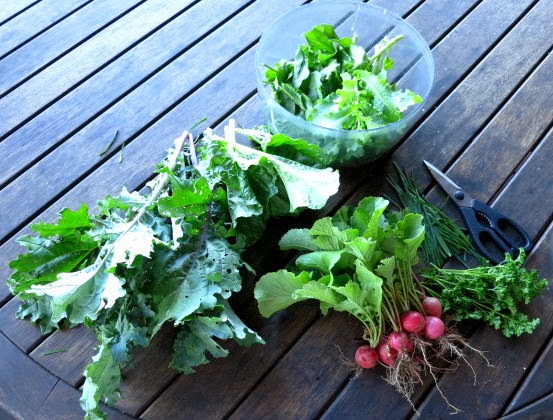
It's been a while since I've done a feature on What's For Dinner?...here we have a sampling of some greens and veggies to add into tonight's mix.  Radishes are still growing really well here.  It's simply a matter of planting some seeds, waiting a few weeks and then planting some more seeds; that way there's always a crop to be harvested.  Some parsley and chives to add some flavour to the relatively bland kale.  Some silverbeet that I stir fried with the kale, and some lettuce for a salad.  Organic gardening is so easy, and tastes so good!

Tuesday, October 22, 2013

This Hill Has Eyes

So I have to admit I've never seen the film that inspired me for this post's title.  When I was adding more green to this north-facing hill recently, I couldn't help but think of the movie as I was planting Carpobrotus Glaucescens, commonly known as 'Pig Face'.  Okay, faces, not eyes, and only one hill, not hills...leave us crazy gardeners alone.


Pig Face is a native creeper with green foliage and bright pink/purple flowers.  What's better; in February the plant produces red, 'sour' strawberries...edible of course.  Perusing the plants at Eden at Byron last week, I noticed native plants on sale; 4 for $20...couldn't resist.  Two of the plants chosen were Pig Face, an excellent addition to this abandoned hill.


Snow peas (below) are meant to be sown in autumn or midwinter at the latest.  These plants went in at the end of winter, I like to push the boundaries and limits of conventional gardening.  From my perspective (correct me if I'm wrong) these peas are alive and well, climbing nicely up this fence I've erected for them.


Zucchini; a plant that never seems to grow well here and always suffers from powdery mildew.  Try as I may to rid the plant of the infected leaves and the white fuzzy spots, the plants never seem to mature enough even to flower.  Behold, a flowering zucchini finally maturing well enough to start fruiting soon.


This is a variety of Cucurbiata maxima, Pumpkin - Baby Blue.  This blue variety comes from the Americas, but seems to like it here in the subtropics.


Cucumbers are another plant, like zucchini, that often have mixed outcomes.  Below are some seedlings finally sprouting up after I added in some 'Mary Sheehan' cucumber seeds last week.  My father will remember the roadside stand we bought these seeds from on our way to Crystal Castle.


And last but not least, Jap pumpkins basking on a sunny spring day...


All in all, there may not be any 'eyes' on this hill, but there are certainly 'faces', flowers, and fruits galore. The snow peas should start producing in the coming weeks, and the pumpkins are all waiting for gravity to take over so they begin climbing (or falling) along the hill.


Monday, October 14, 2013

Crystal Greens

Tucked peacefully up in the hills southwest of Mullumbimby in the Byron Bay hinterland is a labyrinth of gardens filled with beautiful flowering plants and some gigantic crystals.  I thoroughly enjoy the tranquil spirit flowing through this space, The Crystal Castle.  Something new I found this time grabbed even more of my attention...the vegetable garden!


There are nearly ten raised beds here on this sunny hill, with a variety of vegetables, herbs, greens, and inspiration for home-gardeners.


This rainbow chard is a mix of different colors and varieties, and everything looks healthy and happy here.  I wonder how these vegetables would look growing at the foot of some of the massive crystals around here...any thoughts @CrystalCastleBB?


The best part of this vegetable garden, and a design I plan to incporporate soon into my north-facing garden, are these sun shades.  Perfect for some of the more vulnerable lettuces, young seedlings, tomatoes; all vegetables that are subject to sun stress.  The sun is a really important element to growing food for myself all year round, but there are times that my plants could really use a bit of shade, and these screens are going to be a great solution.


Tuesday, September 24, 2013

Life in the Hill Part II

Last friday I introduced to you a new garden I'm working on; a rocky hill (really just a rock pile from debris that was cleared) that needs some life put back into it.  On one hand, the hill does still look like this from afar...


However, take a closer look, and you'll see all of the seedlings starting to really take shape.  First, all of the Jap Pumpkins I've planted, in three different places...


Above and below, you'll see eight Jap Pumpkins still remaining in the area that I initially planted all of the seeds; and since then have transplanted (another eight in total) seedlings to different areas.


The image above also gives you a perspective of the structure I just put in place today, getting ready for the young snow peas coming into their own beneath the 'fence'.


And last but not least, another bunch of pumpkins coming up.  These guys are Pumpkin - Baby Blue, one of the many varieties in the Cucurbita maxima species.  As a matter of fact, this species is said to have more cultivated forms than any other crop...this one happens to be a Baby Blue variety from the Americas.  The Jap Pumpkin seeds were collected from my last harvest (in a different area that I've been working to revitalize) but these Baby Blue seeds were purchased from Eden Seeds.


I'll continue to keep you posted as the life I'm adding back into the hill continues to rebuild itself and the soil beneath.

Creative Commons License
Add More Green by Nick Kovaleski is licensed under a Creative Commons Attribution-NonCommercial-NoDerivs 3.0 Unported License.