Showing posts with label veggies. Show all posts

Monday, June 23, 2014

Everett Street Garden

Four friends from high school asked me to build them a garden in their backyard.  Adjacent to a large cemetery, I quickly found that the condition of the soil was going to be very easy to work with. Additionally, the spot we chose for the garden get's a serious 9-10 hours of sunlight daily (which can be too much for some plants) but is certainly a good amount of sun for a new vegetable garden.

Here's what the area looked like as I started to get the ground prepared.


After taking off the layer of grass and moving that aside to continue growing on the lawn, I forked the entire area to get some air and light into the ground.  Although I planned to build a no dig garden, I did want the bottom of the garden to be as arid as possible.


Next, it was time to start building up.  First, a few layers of leaves and newspaper.


Here's what the area looked like after a few layers of all that organic matter.  The inks from the paper might not be the best for the garden, but the paper will break down naturally over time and help condition the soil by keeping in additional moisture.


Finally, I built up small areas of soil where I planted the initial bunch of veggies; I filled in the other areas with leaves, knowing that I would be adding more soil, compost, manure, etc. to the garden in due time.


This is still a work in progress, but here's what the garden looks like most recently; currently growing in the garden: tomatoes (three varieties), capsicums (three varieties), green beans, snap peas, eggplant, parsley, cucumber, zucchini, watermelon, radishes, lettuce, arugula...


Friday, May 10, 2013

Name That Vegetable

One of the beauties of composting is that you never know what seedlings and starts will perk up out of the soil on a daily basis.  Sometimes these volunteers are not so good for your veggie garden, like papaya or the rampant lemon grass (both better in the ground or lemon grass in a pot).  But sometimes you get surprised with wonderful veggies that addmoregreen.  Take this peculiar squash-like vegetable for example...


I added some of this greatness to the pizza I made tonight, the only issue is that I have no idea what the vegetable actually is.  When I initially let the volunteer take off, I thought the cotyledons resembled those of a cucumber...boy was I wrong!  So, I need some help on this one if anyone knows what vegetable this is...in any case it was delicious!

Saturday, April 13, 2013

What's For Dinner?

Before preparing dinner every day I step out to the garden first to check what fresh veggies I can base my dish upon for the evening.  Tonight, what's for dinner? GREENS!


These greens were all planted about a month ago from seedlings and they've taken off...I can easily pick from any of the varieties daily.


Above we have Silverbeet, Asian Cabbage Tokyo Bekana (crazy name I know), Basil, and more Cabbage.


Rocket and Bok Choy in the other bed.  I've been adding Rocket to my hummus lately and it's delicious.


Tonight I'm going to add Bok Choy, Silverbeet, and Asian Cabbage Tokyo Bekana to a yummy pasta dish...hope my friends coming over enjoy it!

UPDATE

Friday 13 September, 2013

This post has now become the first in a series focused on some of my daily harvests from the garden.


Wednesday, October 24, 2012

They Wrote The Book

Michel and Jude Fanton started an organization in 1986 that in my opinion could solve billions of cases of starvation if their voice were to reach enough of a global audience.  The couple would have been my favorite professors if they had been employed by Babson College while I was there.  Together they bring about a passion in each other to share their vision with everyone listening and have really found an exciting way to AddMoreGreen.  
I recently had the opportunity to visit their house and incredible gardens when they hosted a Seed Savers' Open Garden Day at their home in Byron Bay.  The morning was comprised of educational experiences to broaden our fruit and vegetable vocabulary.  They also shared their personal takes on making curry powder, made entirely with home grown ingredients.  Pictured below are just some examples of potential combinations and below that is a chalkboard full of ideas.
 Superfoods rock!
Now on to the real inspiration, for me at least.  Their veggie beds were jam-packed with green goodness of all sorts.  After all of these years figuring out what works best they have a soil consistency that makes you want to bathe in it.  No mulch needed here because all of the bad stuff has already been weeded out...literally.  What makes me happiest is that they've found an incredible way to regenerate and sustain their garden season after season...it self-seeds!  What else could we expect from Seed Savers?
Can you figure out what all of these yummy vegetables are?  Maybe you should get your copy of the Seed Savers' Handbook which is also jam-packed with green goodness.  Listed inside are more than one-hundred veggies, herbs, and edible flowers with information on origins, cultivation, usages and more.
 and it goes on...
 ...and on...
 ...on some more...
 ...they @addmoregreen everywhere!...
 ...and finally to the compost!  I know I'm happy with the compost that brought my garden back to life but Michel mentioned that these guys have a five year plan.  When it comes to thinking about the future it's really important to forget all the negativity, and simply focus on what your needs will be in the coming years.  Composting, self-seeding, saving seeds; all of these components add up to one really important outcome...food for the future.  We're going to need it, and with the help of Michel and Jude we will all be a little closer to feeding the mouths of many.


Thursday, October 4, 2012

Victory Is Sweet

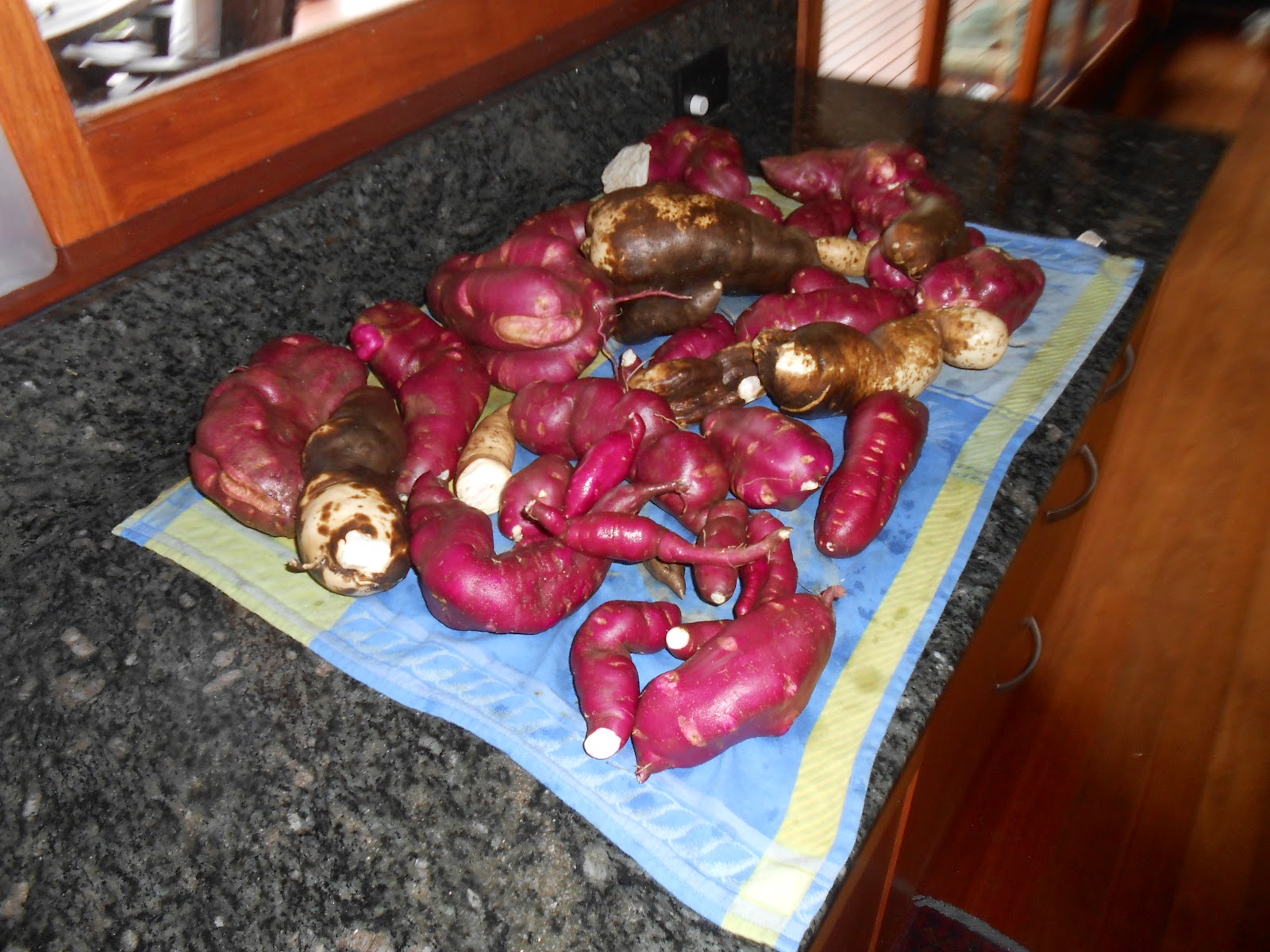
In April of this year before leaving for the US, we planted a considerable amount of sweet potato vines on an underutilized area of the property in an effort to @addmoregreen to our diets (vegetarians always like more options).  For the two months before leaving Australia, I watered the area religiously everyday, making sure that the area remained well quenched (although not too wet because sweet potatoes do not like waterlogged soil).  With vines that were only a few months old I was afraid for their future but as you can see below, mission accomplished!  Now that we've returned home we have started to harvest the crop and have only just scratched the surface; this pile of sweet potatoes is about 5% of what remains uncovered.
Before our existence on Kookaburra Hill, this area was a large banana plantation that was devastated by Bunchy Top and wiped out the entire farm.  Since that time, molasses grass has taken over most of the area where bananas used to thrive.  However, thanks to some hard work and determination we have cleared out a 150 sq. metre plot to begin what we hope to be a great permaculture garden some day.  The vines lay on a hill that is entirely north facing and receive sunlight from sunrise to sunset.  Below is the current state of the area with sweet potato vines going wild!
This was my first time ever cultivating and harvesting sweet potatoes and I'm extremely happy for how successfully it went.  Now that we have a great groundcover established our next step to advance the area will be to plant small fruit bushes that will continue providing us with delicious foods!  My next immediate challenge is to figure out what to do with all of these sweet potatoes, two of us can only eat so much starch.  Any ideas of great ways to distribute massive amounts of sweet potatoes would be greatly appreciated in the comments section.

Tuesday, October 2, 2012

Back To Life

After 17 weeks away from home you can only imagine the state my garden was in.  Although there was a couple renting the house for the better part of 14 weeks, and although they seem to be hobby gardeners, there was certainly plenty of work to be done.  It's now been almost 8 weeks without a serious rain here in Northern NSW and man does the soil tell the story...rock solid. Another surprise I came across were ashes from the fireplace that had been added to the raised beds.  Turns out ash can be used as a great input for compost as it adds valuable nutrients and can deter insects & weeds from accumulating.  I started by forking the beds in order to loosen the soil and prepare all the areas where I planned to @addmoregreen.
Below is a display of how we have the compost setup at home.  On the left are two small trash bins that are used on a daily basis for kitchen scraps such as orange peels and egg shells (only Guy eats eggs though).  When those bins are full we add their contents (usually quite smelly) to one of the larger bins on the right.  The triangle shaped bin takes much longer to process as the contents sit stagnant for much of the time unless you have a compost turning tool.  The tumbler on the right is our greatest piece of compost equipment.  When I go out each day with the kitchen scraps to add to the trash bins I give the tumbler a good six or seven spins which speeds up the process...nearly twice as fast as the triangle bin.
Next, I took the contents from the tumbler which were ready after our 17 weeks away from home and added them to the areas I already forked.  To this mix I added Yates Dynamic Lifter and Searles 5 In 1.  With freshly forked soil and natural fertilisers added to the beds, I stirred it all together using my garden fork again and then gave the beds a nice drink of water to settle the fertilisers in place.  Now that the soil was ready for new plants I spread out the "starts" in an arrangement that would allow each to get an optimal amount of sun while also working off each other in a permaculture sense (basil near the tomatoes, etc.).
And finally, I got my hands dirty...NO GLOVES!
I hope this post has been a great example for turning your old and worn out soil into something more useful and beautiful.  Let us know what you thought about this post in the comments section.  Take a peek at the pictures below to see exactly what I added to the garden.  Also, be sure to check back for upcoming posts as I will be posting more pictures as all of these plants progress!
Lettuce- Mignonette Mixed
Found these vines growing in two different pots when I got home.  Initially, I thought it was pumpkin but a friend added her input stating the vines are watermelon...I suppose we will have to wait and see when these plants begin to produce.
Tomatoes!
Lettuce- Mixed
Roma Tomatoes
Silverbeet- Fordhook Giant
Eggplant


Saturday, September 15, 2012

Glenora Greens

Glenora Distillers, based on Cape Breton Island in Nova Scotia, is the distiller of Canada's only Scottish-style single malt whisky.  They also craft several specialty whiskies and rums, and in the event that you feel incapable of driving home there is no need to worry because you can stay at the Glenora Inn & Distillery, a very tranquil bed and breakfast.
Hidden behind a door that was conveniently marked "Employees Only" I stumbled upon this...
Running a tourist attraction such as the Glenora Distillery with a restaurant included requires the help of a great chef; and that great chef (at least in my opinion) requires immediate access to the freshest herbs and spices at any time.  Luckily, here at Glenora the chef has just that.  Check out the wide variety of greens this kitchen has to work with...
 Pineapple Mint...never heard of that one (it tasted great though)!
 Oregano, Cilantro, Parsley (Italian and regular), French Tarragon...you name it!
@GlenBreton is another great organization who knows how to @addmoregreen.

Thursday, September 13, 2012

Farmers Feed Cities!

Halifax in Nova Scotia has a farmers market that has been alive and running for 262 years...we were lucky enough to gather some grub from a few vendors for lunch and dinner on our way back into the US.  The farmers market is located in the Keith's Brewery building on Lower Water Street.
Since 1750, these farmers have been providing the seaside city of Halifax with a variety of fresh vegetables, fresh fruits, meats, cheeses, seafood, baked goods, jams, jellies, and crafts.  The market operates on Saturdays from 7AM until 1PM...plenty of time for everyone to get their weekly supplies.
We decided to get our produce from this farmer, who informed us that everything left of that yellow bin of potatoes and the silver beet on the table was organic.  That's local  and sustainable farming at it's finest.  This is the mindset that @addmoregreen would like to teach young farmers in Central America.  Deciding to grow organically does excellent things for human health and the health of the environment...it just makes sense.
Check out this awesome grafitti...and more about the historic farmers market in Halifax on their website  and through their twitter account @brewerymarket
FARMERS FEED CITIES!


Thursday, September 6, 2012

Victory For All

While in Boston recently, we stumbled upon the Fenway Victory Gardens.  If you check out their website you'll find out about their history and how to sign up for FGS membership.
 A great place to stop and rest for a while after a bike ride.  If you need a snack maybe you'll be lucky enough to stumble upon a gardener who you can ask to share the wealth.
For the past 70 years in Boston, the Fenway Garden Society has been able to @addmoregreen through the use of public land.


Creative Commons License
Add More Green by Nick Kovaleski is licensed under a Creative Commons Attribution-NonCommercial-NoDerivs 3.0 Unported License.